卡塔蘭數
只要一個問題可以被拆成「左邊一個小問題 + 右邊一個小問題」,
而且所有可能切法都要加總,就很可能是 Catalan number。
第 0 項到第 19 項的卡塔蘭數為:
1, 1, 2, 5, 14, 42, 132, 429, 1430, 4862, 16796, 58786, 208012, 742900, 2674440, 9694845, 35357670, 129644790, 477638700, 1767263190
公式
\[
C_n = \frac{1}{n+1} \binom{2n}{n} = \frac{(2n)!}{(n+1)!n!}
\]
\[
其中,\binom{2n}{n} = \frac{(2n)!}{n!(2n-n)!} = \frac{(2n)!}{n!n!}
\]
程式
用原式,(2*25)!會爆掉 long long 裝不下
#include <bits/stdc++.h>
using namespace std;
#define int long long

vector<int> dp(2 * 21, -1);

int f(int x) {  // !

    if (x == 0) return 1;

    if (dp[x] != -1) return dp[x];

    return dp[x] = f(x - 1) * x;

}

signed main() {
    vector<int> c(21);

    c[0] = 1;

    for (int n = 1; n <= 20; n++) {
        c[n] = f(2 * n) / (f(n + 1) * f(n));
    }

    int n;
    while (cin >> n) {
        cout << c[n] << "\n";
    }

    return 0;
}
參考圖片
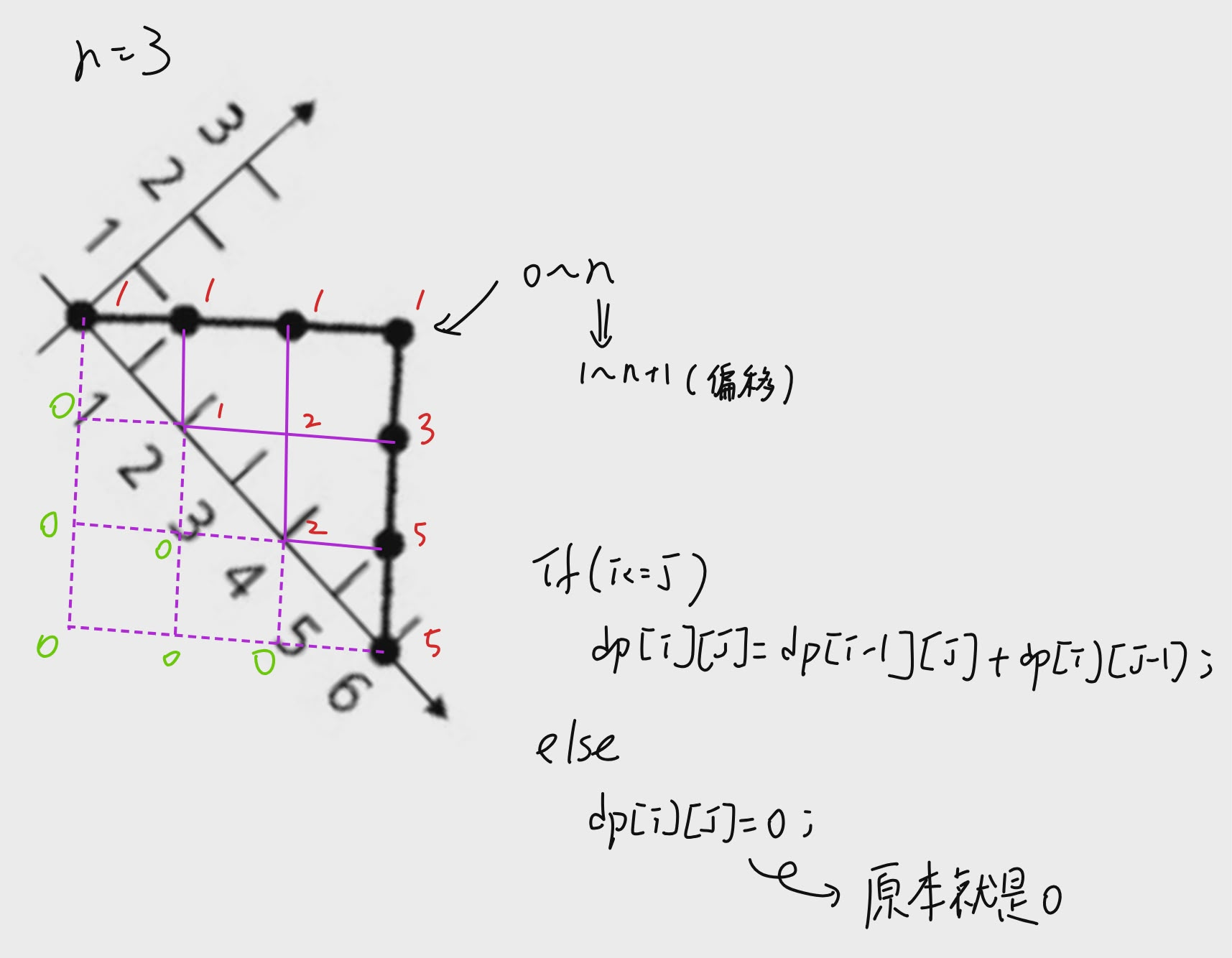
用表格,不會爆掉,一維
#include <bits/stdc++.h>
using namespace std;
#define int long long

signed main() {
    vector<int> c(26);

    c[0] = 1;

    for (int i = 1; i <= 25; i++) {
        for (int j = i; j <= 25; j++) {
            c[j] += c[j - 1];
            // cout << c[j] << " ";
        }
        // cout << "\n";
    }

    int n;
    while (cin >> n) {
        cout << c[n] << "\n";
    }

    return 0;
}
用表格,不會爆掉,二維
#include <bits/stdc++.h>
using namespace std;
#define int long long

signed main() {
    vector<vector<int>> dp(27, vector<int>(27));

    dp[1][1] = 1;

    for (int i = 1; i <= 26; i++) { //偏移
        for (int j = 1; j <= 26; j++) {
            if (i == 1 && j == 1) {
                continue;
            }
            if (i <= j) {
                dp[i][j] = dp[i][j - 1] + dp[i - 1][j];
            }
        }
    }

    int n;
    while (cin >> n) {
        cout << dp[n + 1][n + 1] << "\n";
    }

    return 0;
}
推導後
#include <bits/stdc++.h>
using namespace std;

#define int long long

signed main() {
    vector<int> C(26);

    C[0] = 1;

    for (int n = 1; n <= 25; n++) {
        C[n] = C[n - 1] * (4 * n - 2) / (n + 1);
    }

    int n;
    while (cin >> n) {
        cout << C[n] << "\n";
    }

    return 0;
}
應用
- \(C_n\) 表示長度 \(2n\) 的 dyck word 的個數。Dyck 詞是一個有 \(n\) 個 X 和 \(n\) 個 Y 組成的字串,且所有的前綴字串皆滿足 X 的個數大於等於 Y 的個數。以下為長度為 6 的 dyck words:
XXYYYY XYXXYY XYXYXY XXYYXY - 將上例的 X 換成左括號,Y 換成右括號,\(C_n\) 表示所有包含 \(n\) 組括號的合法運算式的個數:
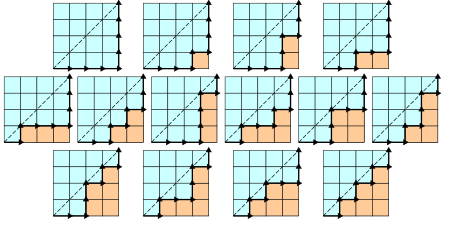
((())) 、 ()(()) 、 ()()() 、 (())() 、 (()()) - \(C_n\) 表示所有在 \(n \times n\) 棋盤中不越過對角線的單調路徑的個數。一個單調路徑從左下角出發,在右上角結束,每一步均為向上或向右。計算這種路徑的個數等價於計算 Dyck word 的個數:X 代表「向右」,Y 代表「向上」。下圖為 \(n = 4\) 的情況:
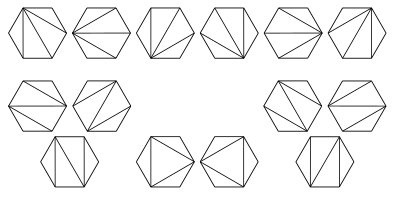
- \(C_n\) 表示通過連結頂點將 \(n + 2\) 邊的凸多邊形分成三角形的方法個數。下圖中為 \(n = 4\) 的情況:
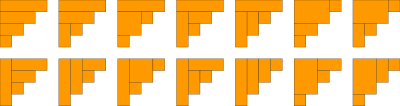
- \(C_n\) 表示不用 \(n\) 個長方形填充一個高為 \(n\) 的階梯狀長方形的方法個數。下圖為 \(n = 4\) 的情況: